







Certified Shungite: How We Verify the Authenticity of Karelian Stone
We stand behind the authenticity of every shungite product we sell. Since 2018, Shungite Tolvu has worked with genuine Karelian shungite and supported the material we use with voluntary certification, laboratory documentation, and traceable sourcing.
SHUNGITE TOLVU is also a registered trademark in the European Union (EUIPO registration No. 019054126), the United Kingdom (registration No. UK00004079353), and the United States (USPTO registration No. 7423384). For us, certification and registration are not marketing decorations. They are part of being accountable for what we sell and giving customers information they can review for themselves.
Authenticity at a Glance
| What we document | Details |
|---|---|
| Material source | Karelia, Russia |
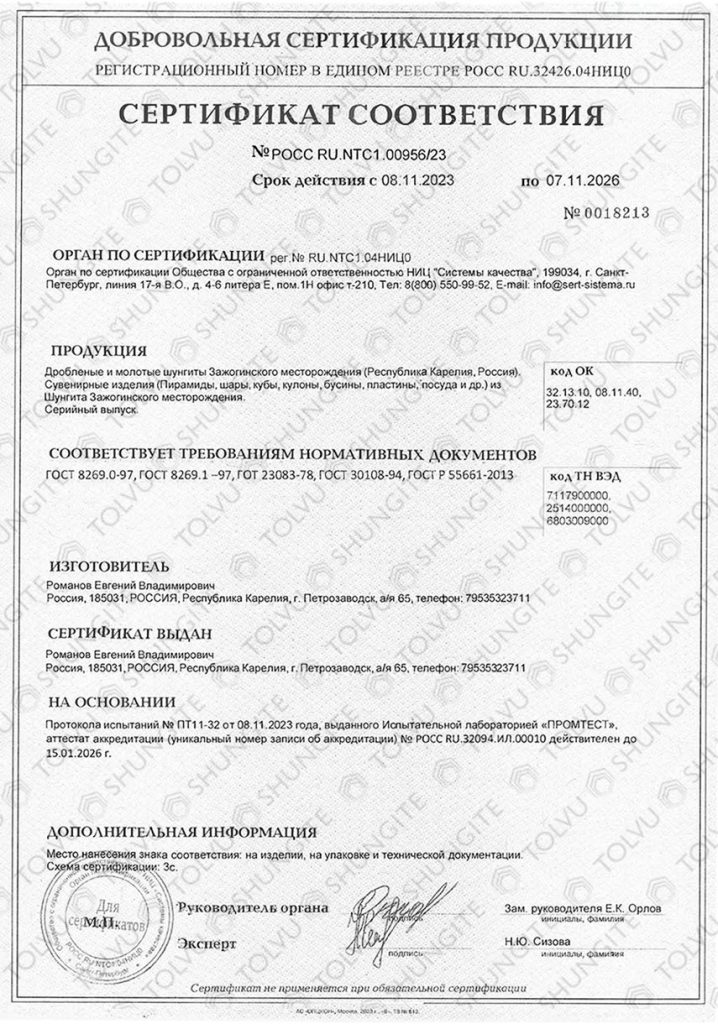
| Voluntary certification | First issued in 2020 and renewed in 2023 |
| Laboratory documentation | Analysis associated with the Institute of Geology of the Karelian Research Centre, Russian Academy of Sciences, in Petrozavodsk |
| Testing methods | Methods shown in the relevant reports may include quantitative chemical analysis and X-ray fluorescence analysis |
| Trademark protection | Registered in the European Union, the United Kingdom, and the United States |
| Customer assurance | Every shungite product is backed by our authenticity guarantee |
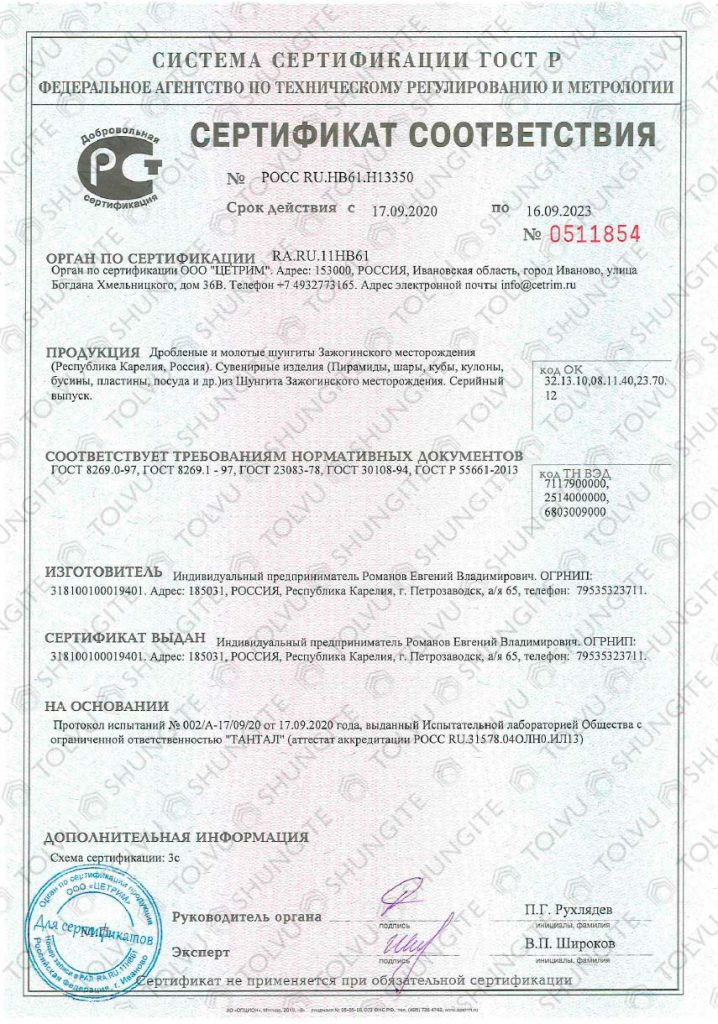
What Our Certification Covers
The certification and laboratory reports apply to the shungite material used in our products. They support the identification, composition, and documented characteristics of the analyzed material.
This does not mean that every pendant, bracelet, pyramid, sphere, or other finished design is sent to a laboratory and tested as a separate manufactured item. Finished products are made or completed using shungite material supported by the corresponding certification and laboratory documentation.
Certificate History and Validity
Our voluntary shungite certification is valid for a defined period and must be renewed to remain current. We received our first certificate in 2020 and renewed it in 2023. The next renewal is scheduled for November 2026.
- 2020: first voluntary certification obtained;
- 2023: certification renewed;
- November 2026: next scheduled renewal.
Why We Chose Voluntary Certification
Under the applicable Russian rules referenced in our documentation, natural shungite is not included among the materials that require mandatory certification for normal intended consumer use. Many sellers can therefore offer shungite without obtaining independent certification.
Shungite Tolvu chose voluntary certification because customers deserve more than a seller-created label. As shungite has become more popular, misleading descriptions, visually similar black stones, and pressed composite products have also become more common. Independent documentation provides a stronger basis for trust than appearance, price, or advertising language alone.
A seller-designed certificate is not equivalent to a laboratory report or an independently issued certification document. A useful document should identify the issuing organization, the material or product covered, the relevant testing or certification basis, and the period of validity.
Laboratory Analysis in Petrozavodsk
The shungite material used by Shungite Tolvu has been examined through laboratory analysis in Petrozavodsk, Karelia, including work associated with the Institute of Geology of the Karelian Research Centre of the Russian Academy of Sciences.
Depending on the sample and the specific report, the documented analysis may include:
- carbon content;
- mineral and elemental composition;
- electrical conductivity;
- structural characteristics;
- quantitative chemical analysis (QCA);
- X-ray fluorescence analysis (XRF).
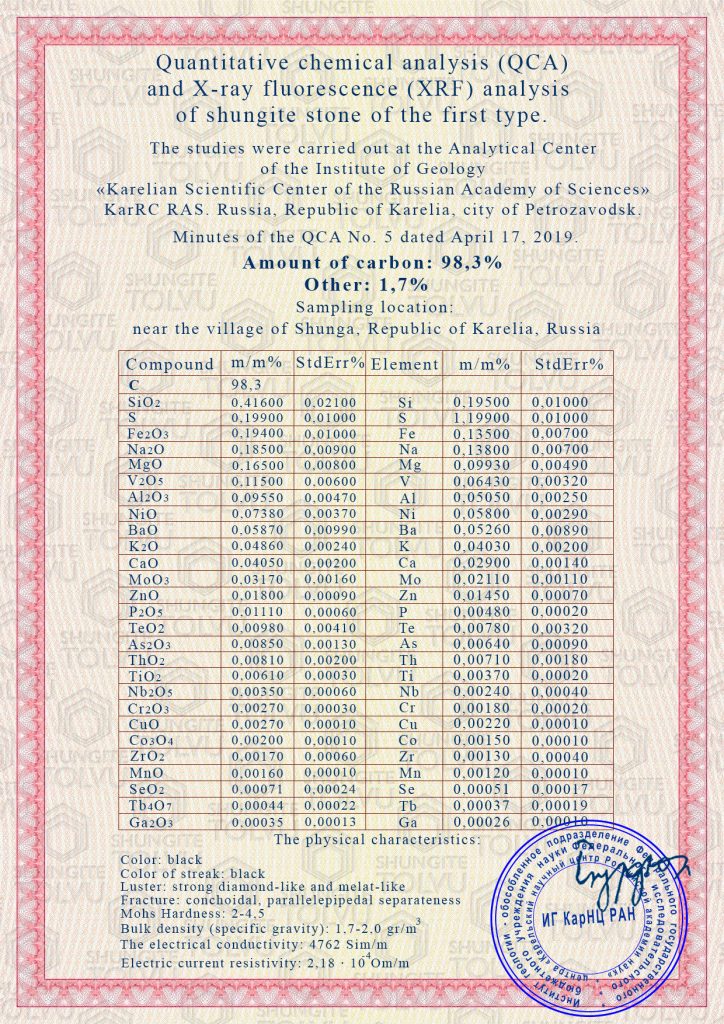
These results help identify the material and distinguish genuine shungite from stones or manufactured products that may look similar in photographs. The specific findings should always be read from the corresponding report rather than inferred from color, shine, or a single home test.
Understanding the Main Types of Shungite
Shungite is commonly described in commercial and geological classifications according to appearance, structure, and carbon content. Terminology and percentage ranges can vary between sources and individual specimens, so the values below should be understood as typical commercial ranges rather than universal limits.
- Type I shungite, widely known online as elite shungite, contains approximately 98% carbon, as confirmed by our laboratory analysis. It has a distinctive silver-toned appearance and is naturally fragile, so it is usually offered as raw specimens or used selectively in handmade pieces.
- Type II shungite: a carbon-rich natural stone with visible mineral variation. Commercial descriptions often place it around 60% carbon, an intermediate range between Type I and classic black shungite, although the exact composition varies by specimen and classification system.
- Classic black shungite, sometimes described as Type III: a durable dark material commonly used for carved products, jewelry, pyramids, spheres, tiles, and engraved pieces. The material used for many of our classic black products has documented carbon content of approximately 30–35%, depending on the analyzed sample.
Natural shungite may contain quartz, pyrite, or other mineral inclusions. Veins, small surface marks, variations in color, and differences in weight are normal characteristics of natural stone and do not by themselves indicate poor quality or artificial manufacture.
Why Appearance Alone Is Not Proof
Not every black or metallic stone sold as shungite is genuine Karelian material. Hematite, anthracite, magnetite, obsidian, manufactured silicon-based products, and other carbon-rich or metallic-looking materials may resemble shungite in photographs.
Some misleading names also appear in online listings. Terms such as “Colombian shungite” or “terahertz shungite” do not by themselves establish that the material is geological shungite from Karelia. “Terahertz stone,” for example, is generally used for a manufactured silicon-based material and is not shungite.
The strongest practical evidence comes from several factors considered together:
- documented source;
- independently issued certification;
- laboratory reports;
- material composition;
- natural structure and inclusions;
- physical measurements interpreted correctly.
No single visual clue or home test should be treated as conclusive proof.
Common Materials Confused with Shungite
- Hematite: an iron-rich mineral that can be dark, metallic, and visually similar to polished elite shungite. Appearance alone is not enough to distinguish the two.
- Anthracite: a hard, carbon-rich form of coal that may have a layered texture and glossy surface. It is not geological shungite.
- Magnetite: a strongly magnetic iron oxide mineral. Solid natural shungite is not normally strongly magnetic, although natural inclusions can influence a reading. When shungite is ground into a very fine powder, below roughly one micron, it can occasionally show weak magnetic properties. This happens because natural iron-bearing inclusions such as pyrite become more exposed at that scale, and extremely small particles can behave differently under a magnetic field, an effect known as superparamagnetism, observed in many natural minerals once pulverized. A slight magnetic reaction in shungite powder is a normal, scientifically explained result of particle size rather than a sign of impurity or a fake material on its own.
- Obsidian: volcanic glass that can be glossy and black but has a different geological origin and composition.
- Manufactured silicon-based “terahertz stone”: an industrial material sometimes marketed beside shungite products, but it is not natural shungite.
- Pressed composites: crushed material mixed with resin or another binder and molded into a finished shape. A composite may contain some shungite powder, but it is not the same as a product carved from solid natural stone.
Electrical Conductivity as a Supporting Indicator
Shungite products have measurable electrical conductivity, which is unusual for ordinary natural decorative stones. For this reason, electrical conductivity can serve as a useful supporting indicator of authenticity when it is considered together with laboratory documentation and other evidence.
Readings can vary widely depending on:
- the type of shungite;
- carbon content and mineral inclusions;
- the distance between the meter probes;
- surface finish and cleanliness;
- contact pressure;
- moisture;
- the meter range and testing method.
For these reasons, there is no single resistance value that every genuine piece must produce. A multimeter reading does not by itself prove geographic origin, carbon percentage, or product quality. It is one physical observation, not a substitute for professional analysis.
Why Some Customers Mistake Polished Shungite for Plastic
Highly polished shungite can sometimes look surprisingly smooth and lightweight compared with many other decorative stones. Because shungite is carbon-rich and can develop a glossy surface after polishing, some customers may initially wonder whether a pendant, pyramid, or other finished piece is made from plastic rather than natural stone.
A simple flame test is sometimes mentioned online as a way to distinguish stone from plastic: plastic may soften, melt, deform, or produce a chemical odor when exposed to a flame, while solid natural shungite will not behave like ordinary plastic during brief exposure. However, this is not a conclusive authenticity test, because many other natural and artificial mineral materials also do not melt or burn under a lighter flame.
We do not recommend applying an open flame to a finished product. Heat can damage cords, adhesives, coatings, metal settings, engraved finishes, or other non-stone components, and may produce harmful fumes. The safer and more reliable ways to evaluate shungite are laboratory documentation, traceable origin, natural structure, and electrical conductivity testing with a multimeter.
Solid Natural Stone, Not Pressed Composite Material
Our carved shungite products are cut and shaped from solid natural stone. We do not manufacture them from shungite powder mixed with resin, pressed into molds, or dyed to imitate the natural color of the material.
Pressed or molded products can look nearly identical because they come from the same form. Natural stone retains its own weight, texture, veins, inclusions, and small surface variations. That is why genuine carved pieces are not perfectly identical.
Raw stones, powder, beads, and finished products naturally require different production methods, but the shungite material itself is selected and described according to its documented type and intended use.
Elite Shungite from Karelia
We offer genuine elite shungite specimens sourced from Karelia, including material associated with the historical Shunga area from which the name “shungite” is derived.
Elite shungite is naturally fragile and limited in supply. It is therefore usually sold as an individual raw specimen or used selectively in handmade jewelry rather than mass-produced geometric forms.
Our elite shungite samples have been supported by laboratory work in Petrozavodsk. Depending on the sample, the available reports include methods such as quantitative chemical analysis and X-ray fluorescence analysis. These reports document the composition of the analyzed material.
Origin Claims and Misleading Product Names
Karelia is the best-known and commercially established source of geological shungite. The Zazhoginskoye deposit is widely recognized as the principal large-scale, industrially developed source associated with commercial shungite products.
Other regions may contain carbon-rich rocks, coal, bitumen-like materials, or visually similar minerals. That does not automatically make those materials equivalent to Karelian shungite in geological composition or commercial classification.
For this reason, labels such as “Canadian shungite,” “Colombian shungite,” or “Ukrainian elite shungite” should be supported by independent geological and laboratory documentation rather than accepted on the name alone.
Trademark Registration and Brand Accountability
SHUNGITE TOLVU is a registered trademark in three major jurisdictions:
- European Union: EUIPO registration No. 019054126;
- United Kingdom: registration No. UK00004079353;
- United States: USPTO registration No. 7423384.
Trademark registration does not prove the composition of a mineral. Laboratory documentation serves that purpose. The registrations do, however, identify the business and brand standing behind the claims, products, and customer guarantees presented on this website.

What Our Documents Do, and Do Not, Prove
Our certification and laboratory reports support the authenticity and analyzed composition of the shungite material covered by those documents. They provide a stronger basis for trust than a seller-created certificate with no independent institutional support.
The documents do not mean that the issuing institution:
- recommends Shungite Tolvu;
- endorses every finished design;
- guarantees a health or wellness result;
- guarantees water-treatment performance in every use;
- guarantees a specific level of electromagnetic protection from an individual consumer product.
Scientific studies have examined the physical, chemical, and electromagnetic characteristics of shungite under specific laboratory conditions. We do not claim that owning or wearing a pendant, bracelet, pyramid, plate, or other product treats a medical condition or guarantees a measurable protective outcome.
Our Authenticity Guarantee
Every shungite product sold by Shungite Tolvu is backed by our authenticity guarantee. We have worked with genuine Karelian shungite since 2018 and have completed more than 10,000 customer orders.
If you have a question about a certificate, laboratory report, shungite type, natural inclusion, or individual stone, contact us before ordering. We will explain which documentation applies and help you choose the product that best matches what you are looking for.
For a broader introduction to the mineral, its geological origin, composition, history, and different types, read our guide to shungite stone.