







About Shungite
Shungite Properties: Composition, Structure and Scientific Evidence
Scientific review updated: August 15, 2026
Shungite is a natural carbon-mineral rock whose properties vary with carbon content, mineral composition, structure, and geological origin. Research on Karelian shungite has documented disordered fullerene-like carbon, electrical conductivity, ion-exchange and sorption behavior, natural mineral inclusions, and electromagnetic interaction under defined test conditions. No single value or property describes every shungite sample.
Shungite Properties at a Glance
- Material type: natural carbon-rich rock, not a single mineral with a fixed formula
- Main components: non-crystalline carbon and mineral phases such as quartz, mica, carbonates, chlorite, feldspars, and pyrite
- Carbon content: variable; published classifications divide shungite rocks into several types
- Carbon structure: disordered graphene layers, nanoscale pores, and fullerene-like formations
- Electrical behavior: conductive, with values depending on carbon content and microstructure
- Sorption behavior: capable of binding certain ions and organic compounds under controlled conditions
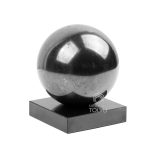
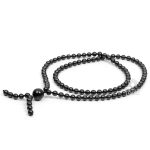
- Appearance: usually black or dark gray, with matte, semi-metallic, or polished surfaces and possible quartz or pyrite inclusions
- Geological age: associated with Paleoproterozoic formations in the Lake Onega region
These are material and geological properties. Claims about treating disease, detoxifying the body, changing emotions, or protecting a person from EMF require separate clinical or product-specific evidence.
Is Shungite a Mineral, a Rock, or a Form of Carbon?
Shungite is often called a mineral in commercial descriptions, but that wording is incomplete. A mineral normally has a characteristic composition and crystal structure. Shungite rock contains carbonaceous matter together with several mineral phases, and its composition can vary substantially. For that reason, geologists commonly describe it as a carbon-rich rock, a carbon-mineral material, or a group of shungite rocks.
The carbonaceous component is also called shungite carbon. It is not ordinary graphite and does not form one uniform crystalline phase. Scientific interest centers on the way its disordered carbon layers, pores, and mineral components are organized at micro- and nanometer scales.
Carbon Content and the Five Types of Shungite Rock
Carbon content is one of the most useful—but not the only—ways to classify shungite. V. V. Kovalevsky’s 2007 doctoral dissertation abstract cites the five-type classification of P. A. Borisov:
| Type | Carbon content | General interpretation |
|---|---|---|
| Type I | 75–98% C | Very high-carbon shungite material |
| Type II | 35–75% C | High-carbon shungite rock |
| Type III | 20–35% C | Medium-carbon rock widely considered for technical applications |
| Type IV | 10–20% C | Lower-carbon shungite-bearing rock |
| Type V | Less than 10% C | Low-carbon shungite-bearing rock |
Other scientific publications use different boundaries, including broader high-, medium-, and low-carbon categories. The classifications reflect different geological and industrial purposes; they are not completely interchangeable.
Dark color alone cannot determine a type. A credible carbon percentage must come from analysis of an identified sample or batch. It should not be inferred from a product photograph, electrical test, or marketing label.
What Is Shungite Made Of?
Shungite rock is a natural carbon-mineral composite. Its non-crystalline carbon occurs together with a mineral matrix. Research has identified quartz, mica, chlorite, albite and other feldspars, carbonates, pyrite, and smaller quantities of accessory minerals.
The proportions and distribution are not uniform. Carbon may form a matrix, isolated concentrations, films around mineral grains, or three-dimensional networks. Mineral components can occur as visible grains, microscopic crystals, nanoscale clusters, or layers associated with the carbonaceous matter.
This explains why two genuine pieces from the same broader region can differ in color, luster, visible veins, density, polish, and electrical response. Natural variation is expected; perfect visual uniformity is not a defining property of shungite.
The Fullerene-Like Structure of Shungite Carbon
Kovalevsky described shungite as a non-graphitizing, fullerene-like carbonaceous material. In this context, “fullerene-like” refers primarily to structural features: curved graphene layers, shell fragments, and packages of carbon layers surrounding nanoscale pores.
His model identifies globular formations on the order of 10 nanometers. Electron microscopy also revealed several morphologies of shungite carbon, including globular, packet-like, flake-like, and film-like forms. These structures contain disordered packages of graphene layers rather than the regular three-dimensional crystal lattice found in graphite.
Researchers have reported fullerene species and larger fullerene-like formations in some samples. That finding should not be simplified into the statement that every shungite stone contains the same quantity of free C60. The detected form and concentration depend on the sample and analytical method.
How Shungite Differs from Graphite
Both graphite and shungite contain carbon arranged partly in graphene-like layers. Their larger-scale organization is different.
- Graphite has a comparatively regular crystalline structure.
- Shungite carbon is structurally disordered and generally non-graphitizing.
- Shungite layers can be curved, interrupted, and arranged around nanoscale pores.
- Shungite is naturally combined with multiple mineral components.
Because graphite, conductive composites, and black resins can reproduce individual features such as color or conductivity, no single home test can conclusively authenticate shungite.
Electrical Conductivity
Electrical conductivity is one of the best-established physical properties of carbon-rich shungite. Conductive pathways form through its carbonaceous component, while the mineral component affects continuity and resistance. Samples with different carbon content and microstructure can therefore produce different measurements.
Conductivity is relevant to research on electrodes, composite fillers, heating materials, and electromagnetic applications. It is also sometimes used as a preliminary identification clue. However, conductivity alone is not proof of Karelian origin because graphite and many manufactured carbon materials are also conductive.
Electromagnetic Interaction
Conductive carbon-mineral materials can reflect and absorb electromagnetic energy. Studies have examined shungite powders, layers, plates, and shungite-containing composites over specified frequency ranges. Their results depend on:
- carbon and mineral composition;
- sample thickness and continuity;
- particle size and processing;
- geometry and surface area;
- frequency and polarization;
- the measurement method and reference material.
These dependencies are central to interpreting the research. The electromagnetic behavior of a laboratory layer cannot be transferred automatically to a pendant, pyramid, loose stone, or small phone plate. Conductivity and experimental shielding are material properties; personal exposure reduction is a separate product-level claim that requires testing of the finished configuration.
Sorption and Ion-Exchange Properties
Shungite has been investigated as a sorbent. Shalimov and colleagues reported that the studied material could sorb inorganic cations and anions, with behavior influenced by solution acidity. The study also found sorption of organic acids, including selective behavior toward aromatic acids.
Sorption is not a universal ability to remove every contaminant. Results depend on the shungite type, surface preparation, particle size, dosage, water chemistry, contact time, and target substance. Modified or heat-treated shungite can behave differently from raw stone.
For this reason, a technical result from a prepared sorbent should not be converted into advice to place an arbitrary decorative object in drinking water. Water treatment must be designed around identified contaminants and verified by appropriate chemical and microbiological testing.
Magnetic and Thermal Behavior
Kovalevsky and colleagues investigated the magnetic behavior of selected shungite carbon samples at reduced temperatures. Some anisotropic samples showed an increase in diamagnetism over a limited low-temperature range. This is a specific experimental observation, not evidence that a room-temperature object changes a person’s magnetic or biological field.
Heating shungite can also transform its carbon and mineral components. Under controlled high-temperature conditions, researchers obtained new hollow carbon structures and silicon-carbide fibers. These processes illustrate the technological potential of the raw material but do not occur during ordinary use of a finished stone product.
Color, Luster, Quartz Veins, and Pyrite Specks
Most commercial shungite is black or dark gray. A cut surface may be matte, semi-metallic, or polished depending on carbon content, mineral composition, texture, and finishing method.
White or pale veins are commonly associated with quartz and other light-colored minerals. Gold-colored specks can be pyrite. Small pits, veins, uneven coloration, and differences in luster are normal possibilities in a natural carbon-mineral rock.
These features can support a geological explanation of the material, but they are not conclusive proof of authenticity. Similar visual effects can be reproduced in other rocks and manufactured products.
What the Scientific Properties Do Not Prove
Materials-science findings should not be presented as clinical conclusions. The properties described above do not establish that a finished shungite product:
- treats inflammation, allergies, anxiety, or other medical conditions;
- detoxifies the body or repairs cells;
- strengthens immunity;
- makes unknown water safe to drink;
- reduces a person’s exposure to EMF or 5G;
- produces measurable chakra, aura, or biofield effects.
For a separate evidence-based discussion of consumer and health-related claims, read Shungite Benefits and Properties: What Science Actually Shows.
How to Evaluate the Properties of a Particular Sample
A useful scientific description should identify both the sample and the method. Depending on the question, relevant evidence may include:
- documented deposit or geographic origin;
- elemental analysis for carbon and other elements;
- mineralogical identification;
- microscopy or diffraction data;
- electrical measurements with stated conditions;
- a clear connection between the analyzed material and the sold product.
The stone used for Shungite Tolvu products is sourced from Karelia, Russia. Our solid-stone items are shaped from natural material rather than pressed shungite powder mixed with resin or synthetic black coloring. Review our shungite authenticity and laboratory documentation.
Frequently Asked Questions
What is the most important property of shungite?
There is no single defining property. Shungite is identified through a combination of geological origin, carbon-mineral composition, disordered carbon structure, and physical measurements.
Why does the carbon content of shungite vary?
Shungite formed as part of complex geological rocks rather than as a purified manufactured material. Carbon and mineral components accumulated and transformed differently across layers, deposits, and structural zones.
Is high-carbon shungite always better?
Not for every purpose. A higher carbon percentage can increase conductivity and change appearance, but technical suitability also depends on mineral composition, structure, processing, and intended use.
Can a multimeter prove that shungite is genuine?
No. Conductivity is a useful clue, but graphite and manufactured carbon composites can also conduct electricity. Provenance and laboratory characterization provide stronger evidence.
Are quartz and pyrite inclusions defects?
No. They can be normal mineral components of natural shungite rock. Whether an inclusion is acceptable in a finished item is a matter of product grading and appearance, not authenticity alone.
Does fullerene-like carbon make shungite medicinal?
No. Structural similarity to fullerenes does not establish a clinical effect. Medical claims require appropriate biological and human evidence for the specific intervention.
Scientific Sources
- Kovalevsky, V. V. Carbonaceous Matter of Shungite Rocks: Structure, Genesis, Classification. Doctoral dissertation abstract, Institute of Geology, Karelian Research Centre of the Russian Academy of Sciences, 2007.
- Kovalevski, V. V., Buseck, P. R., and Cowley, J. M. “Comparison of carbon in shungite rocks to other natural carbons: An X-ray and TEM study.” Carbon, 39(2), 243–256, 2001. DOI: 10.1016/S0008-6223(00)00120-2.
- Buseck, P. R. et al. “Shungites: the C-rich rocks of Karelia, Russia.” Canadian Mineralogist, 35(6), 1363–1378, 1997.
- Kovalevski, V. V., Prikhodko, A. V., and Buseck, P. R. “Diamagnetism of natural fullerene-like carbon.” Carbon, 43(2), 401–405, 2005. DOI: 10.1016/j.carbon.2004.09.030.
- Shalimov, A. S., Kovalevskii, V. V., Obrezkov, O. N., and Yaroslavtsev, A. B. “Sorptive Properties of Shungite.” Inorganic Materials, 40(4), 364–367, 2004. DOI: 10.1023/B:INMA.0000023956.54637.b8.
- Golubev, Y. A. et al. “Electrophysical Properties and Structure of Natural Disordered sp2 Carbon.” Nanomaterials, 12, 2022. Read the peer-reviewed article.
This article describes geological and materials-science properties. It does not provide medical advice or establish therapeutic effects for finished shungite products.