






Shungite Articles: Science and Guides
Shungite and EMF: What the Research Shows
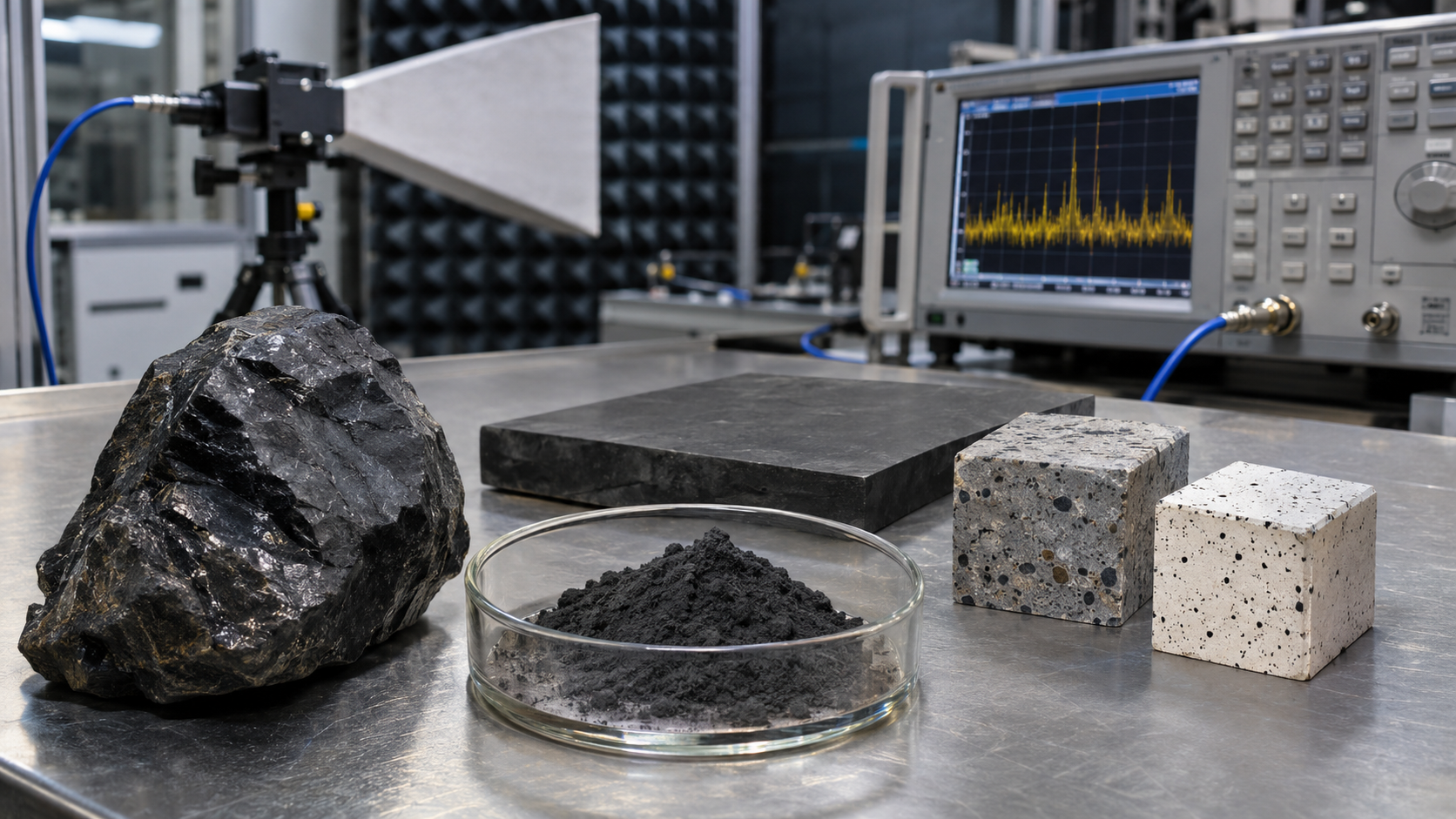
The body of Shungite EMF research is actually quite old and very detailed. Scientists in Russia and Belarus have tested shungite as a plate, a powder, plaster, paint, and concrete. In many of these tests the rock attenuated high frequency radio waves by 10 to 40 decibels.
This article explains the above information step-by-step. It will detail what was measured, the test conditions, and why a cheap EMF meter at home will usually not show any change in EMF levels.
The Short Answer
The interaction of Shungite with electromagnetic radiation has been established through laboratory testing. The results of such testing vary according to the form of the stone, i.e. solid, continuous layers of Shungite versus a collection of Shungite chips.
The best results are achieved with thick plates, with wet powder and with special materials for building such as plaster, panels and paint for shielded rooms.
Why Shungite Reacts to EMF
Most stones are not conductive. Shungite is an exception to this rule.
A special form of carbon in the rock forms many tiny curved layers of carbon, each only a few nanometers across, with quartz and other minerals filling the spaces between them. If the carbon content is high enough then the carbon layers can make contact with each other, forming conducting paths through the rock.
The change from low reflectivity to high reflectivity occurs at carbon contents of between 30% and 50% in the shungite samples studied with 3% to 95% carbon. Above this range, however, reflection rose quickly (Golubev and Antonets, 2017).
Another team has previously reported that shungite with high carbon content has a microwave field conductivity approximately 15 times higher than its direct current conductivity. In other words, the rock becomes more active exactly where radio waves live (Antonets et al., 2020).
What Researchers Measured
Here is a table of results for the shungite EMF studies that we have found in the literature. We have included the test conditions for each of the results, as results on their own are of little use.
| Form of shungite | Test conditions | Result | Source |
|---|---|---|---|
| Thin layers of high-carbon shungite | 8–70 GHz, layers tens to hundreds of microns thick | 40 dB and more | Antonets et al., 2020 |
| Solid shungite plate | Microwave test between two horn antennas | Over 30 dB, mostly by reflection | Shungite conference, 2006 |
| Crushed shungite, particles up to 1 mm | Same test | 10–20 dB | Shungite conference, 2006 |
| Wet shungite powder (53% water) | 8–12 GHz | About 40 dB; drier powder 10–15 dB | Shungite conference, 2006 |
| Loose shungite chips over 5 mm | 100–800 MHz, layer over 15 cm | 20 dB (10 cm is enough when packed) | Shungite conference, 2006 |
| Concrete tile, cement and shungite 1:1, 3.8 mm | 10–18 GHz | 4–9 dB | Belousova et al., 2013 |
| Concrete panel with small pyramids (35% shungite) | 0.7–18 GHz | About 30 dB | Belousova et al., 2013 |
| Shungite plaster, 15 mm | 10–160 kHz / 30–740 MHz | 17–27 dB / 5–14 dB | Shungite conference, 2006 |
| Polystyrene with 65% shungite | Up to 1 GHz | 0.2 dB up to 100 MHz, 3.2 dB at 1 GHz | Rodionov, dissertation |
| Shungite composites (two deposits) | 1 GHz | About 23–32 dB | Moshnikov et al. |
The results of the test can be summarized in two lines. The first line is that solid shungite is better than crushed shungite. This is because the carbon paths in the crushed stone are broken and the shielding power of the shungite is reduced.
The second line is that water is helpful. A wet powder conducts electricity better than a dry one, so adding some moisture to shielding plasters can be helpful.
What About the Pyramids in the Concrete Test?
One interesting thing is that the best concrete panel in the Belarusian study had a surface of small pyramids, each about 4–5 cm tall.
These pyramids are not just some decoration. Engineers are using pyramids in so-called anechoic chambers to trap waves between the surfaces of the pyramids and not reflect them. In the shungite panels, the pyramids raised the shielding to about 30 dB across a very wide frequency range.
What Decibels Mean in Plain Words
Decibels measure the attenuation of a wave as it passes through a material. The figures below refer to signal power.
- 10 dB = 10 times weaker.
- 20 dB = 100 times weaker.
- 30 dB = 1,000 times weaker.
- 40 dB = 10,000 times weaker.
So if a shungite plate is rated for more than 30 dB attenuation, then less than 1/1,000th of the energy is transmitted through the plate.
Why Your EMF Meter Shows No Change
The question “Do EMF meters measure the shielding effect of Shungite?” is one of the most frequently asked questions by our customers. We also used to wonder about this and tested several popular EMF meters bought on online marketplaces. We saw no difference when we placed shungite next to them.
The reason for this is quite simple. Many low-cost EMF meters are low frequency magnetic field meters and measure fields from 50 Hz to 20 kHz. These are typical frequencies for wiring, for transformers and for motors of household appliances.
The fields that Shungite research is dealing with are radio waves of high frequency like Wi-Fi, mobile networks, Bluetooth and 5G. Low-frequency magnetic fields pass relatively easily through non-magnetic materials like Shungite, i.e. a low-frequency magnetic field meter cannot measure the radio wave shielding effect of Shungite.
How to Test It Properly
You can test the radio wave shielding with an RF meter that measures the frequencies of your router or phone.
- Measure the signal near your Wi-Fi router.
- Place a shungite plate or a set of tiles between the router and the meter.
- Measure again from the same spot.
The radio waves travel around small objects. A single small plate of Shungite would leave most of the router uncovered and so there would be little change in the reading. The larger the area of Shungite used, the greater the change in the reading may be.
What Changes the Result
Look for these 5 factors when evaluating shungite EMF shielding.
- Carbon content. Shungites with carbon content of 30-50% or more are generally much better shields than those with less carbon.
- Continuity. A single, continuous sheet of shungite will shield better than multiple fragments of the rock with gaps between them.
- Thickness and size. The larger and thicker the piece of shungite, the better the shielding, under comparable conditions.
- Moisture. Shielding effectiveness of shungite powder can increase when the moisture content of the powder is higher.
- Frequency. The same shungite may effectively shield one frequency of EM field and not another.
Shungite and 5G
The 5G frequency spectrum is divided into two groups of frequencies. Most 5G networks today are operating at frequencies below approximately 7 GHz. In addition to these frequencies, some cities are also operating at millimeter wave frequencies between 24 and 40 GHz.
In concrete panels the interaction of shungite with radio waves was studied in the frequency range of 0.7–18 GHz. The reflection of microwaves on the surface of shungite was studied in the range of 26–39 GHz. The thin-layer study reached a frequency of 70 GHz.
All of the above experiments were conducted with a prepared sample of shungite, i.e. as a plate, layer or panel between the antenna and the receiver. For shielding at these frequencies, shungite can be used in the form of a plaster or paint to be applied on the wall.
Where People Use Shungite Shielding
Shungite is used for more than 20 industrial applications, including EMF shielding. Russian scientists have even patented several types of shungite-based shielding materials and have tested several of them in real-life applications.
For example, in 1996 a ward in the Military Medical Academy in Saint Petersburg was built with a layer of shungite more than 5 cm thick on its walls. The whole screen had a weight of more than 11 tonnes and reportedly achieved attenuation of up to 140 dB at radio frequencies above 30 MHz.
According to a review of shungite applications, the natural magnetic field of the Earth is not distorted by shungite shielding materials, in contrast to metal screens.
Shungite is also used in shielding plaster, concrete, and even paint. Belarusian scientists even created fire-resistant shungite paint, which survived a 1,700 °C flame for more than 3 minutes.
Shungite at Home
In order to provide real shielding throughout a room, a complete layer of shielding is generally required on the walls or in the form of a complete enclosure. This is why we recommend shungite plasters and paints designed for shielding rooms.
Our own pieces, by contrast, are a different thing. We make shungite pyramids, tiles, and phone stickers from the same carbon-rich rock that researchers test in their labs. They are natural stones with a rare composition and a long history.
These pyramids are kept near computers and routers by many of our customers simply because they like to have this stone close to their electronics. If you want to see what genuine shungite looks like in lab analyses, visit our certificate page.
Frequently Asked Questions
Does shungite block EMF?
The studies in laboratory tests showed that shungite materials can weaken the radio waves by 10 to 40 dB. This effect depends on the carbon content, the thickness, the moisture content and the coverage of the material.
Does shungite work against 5G?
Tests of the shungite material for shielding against radio waves included frequencies used by 5G networks, from below 7 GHz up to 70 GHz. The material in the form of plates and layers was tested across the path of the waves.
Which type of shungite is best for EMF shielding?
The best type of shungite for shielding EMF is generally the high-carbon variety. The more carbon in the shungite, the better it generally conducts, and thus the better it can shield. Studies show a dramatic increase in the reflection of microwaves as the carbon content of the shungite increases above about 30–50%. Elite shungite has up to about 98% carbon, while classic black shungite has about 30%.
Is polished or unpolished shungite better?
We are not aware of any studies that compare the polished version of shungite to the unpolished version of shungite. The surface finish of the stone can be altered while the rock itself remains unchanged.
How can I check that my shungite is real?
Check with a multimeter set to 200 kΩ to test the stone’s conductivity between two points on the stone. Genuine shungite conducts electricity, many counterfeit shungite stones do not, but this test on its own does not guarantee that the stone is genuine. It is important to ask for the seller’s lab analysis for verification.
Sources
- Antonets, Golubev, Shavrov, Shcheglov (2020), Structural and conducting properties of graphene-containing shungite, Journal of Radio Electronics, issue 1, doi:10.30898/1684-1719.2020.1.9
- Golubev and Antonets (2017), Mineral features of shungite rocks and their reflection of microwaves at 26–39 GHz, Vestnik of the Institute of Geology of the Komi Science Center, issue 5, doi:10.19110/2221-1381-2017-5-43-48
- Belousova, Mahmood, Lynkov, Nasonova (2013), Radio-shielding properties of concretes based on shungite nanomaterials, Nanotechnologies in Construction 5(2), pages 56–67, open text
- Belousova, Nasonova, Lynkov and co-authors (2013), Fire-resistant shielding coating based on shungite paint, Nanotechnologies in Construction 5(4), pages 97–109
- Belousova, Mahmoud, Lynkou (2013), An effect of annealing on shielding properties of shungite, Nanomeeting 2013, doi:10.1142/9789814460187_0138
- Shungites and Human Safety, proceedings of the First All-Russian Conference, Petrozavodsk 2006, published 2007
- Rodionov, Mechanisms of interaction of microwave radiation with nanostructured carbon materials, PhD dissertation, Southwest State University, Kursk
- Moshnikov, Kovalevsky, Lazareva, Petrov, Use of shungite rocks in radio-shielding composite materials, Institute of Geology of the Karelian Research Centre RAS
- Tyulnin (2010), On priority areas for the practical use of shungite raw materials, Mining Information and Analytical Bulletin